Your visa was refused, or cancelled, and you are still in Australia. Your first instinct might be to lodge a different visa and keep your life here on track. Before you pay another application fee, check whether the section 48 bar applies to you. If it does, most onshore applications are invalid from the moment you lodge them.
This guide explains how the section 48 bar works, which visas are exempt and what your realistic options are after a refusal or cancellation.
What Is the Section 48 Bar?
The section 48 bar comes from section 48 of the Migration Act 1958. It limits which visas you can apply for while you remain in Australia after a refusal or cancellation. Its purpose is to stop people lodging one onshore application after another to extend their stay.
If the bar applies, you can only apply onshore for a visa class listed in regulation 2.12 of the Migration Regulations 1994. Any other application is invalid. The Department will not assess it.
When the Section 48 Bar Applies: The Two-Part Test
Both conditions must be true:
- You are in Australia and do not hold a substantive visa. A bridging visa is not a substantive visa. If a bridging visa is all you hold, you meet this condition.
- Since you last entered Australia, a visa was refused or cancelled. Only certain refusals and cancellations count (see below).
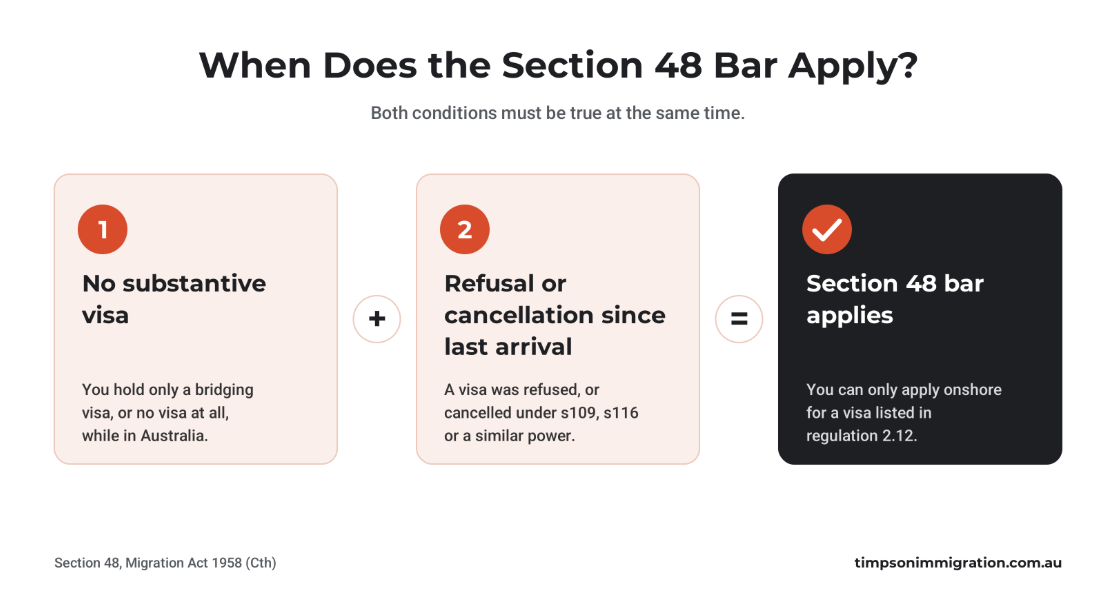
Timing matters. If you were refused while still holding a valid substantive visa, such as a student visa, the bar does not stop you applying for another visa while that student visa remains in effect. The bar takes effect once that visa expires and you are left on a bridging visa.
Section 48 Bar After a Visa Refusal
A refusal of a substantive visa you applied for triggers the bar. This includes applications where you were a secondary applicant or where someone applied on your behalf.
Two types of refusal do not trigger section 48:
- refusal of a bridging visa
- refusal on character grounds under sections 501, 501A or 501B (a separate and stricter bar under section 501E applies instead)
Section 48 Bar After a Visa Cancellation
A cancellation ends a visa you already hold. That usually leaves you without a substantive visa straight away, so a cancellation tends to trigger the bar immediately.
The cancellation powers that trigger section 48 include section 116 (the general power, often used for breach of visa conditions), section 109 (incorrect information) and sections 133A, 133C, 134, 137J and 137Q. If your visa was cancelled, read our guide to visa cancellation before you take any other step.
Section 48 Bar Decision Tree
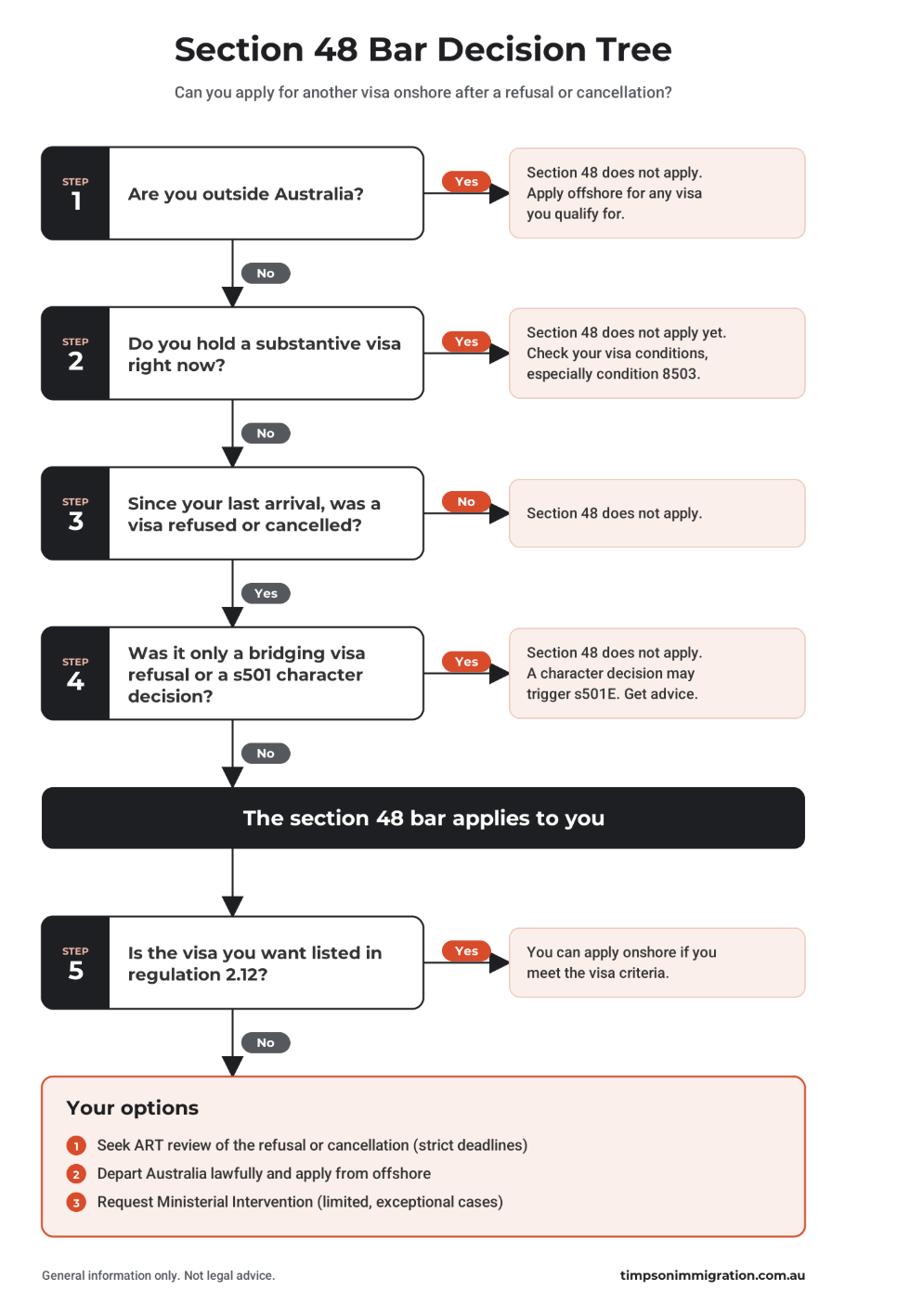
Work through these steps in order:
- Step 1: Are you outside Australia?
- Yes → Section 48 does not apply. You can apply offshore for any visa you qualify for.
- No → Go to Step 2.
- Step 2: Do you hold a substantive visa right now?
- Yes → Section 48 does not currently apply. Check your visa conditions, especially condition 8503 (No Further Stay).
- No → Go to Step 3.
- Step 3: Since your last arrival, was a visa refused or cancelled?
- No → Section 48 does not apply.
- Yes → Go to Step 4.
- Step 4: Was it only a bridging visa refusal or a section 501 character decision?
- Bridging visa refusal only → Section 48 does not apply.
- Character decision → Section 501E may apply. Get legal advice now.
- Neither → The section 48 bar applies. Go to Step 5.
- Step 5: Is the visa you want on the regulation 2.12 list?
- Yes → You can apply onshore if you meet the criteria.
- No → Your options are an ART review, lawful departure and an offshore application, or Ministerial Intervention in limited cases.
Section 48 Bar Exemptions: Visas You Can Still Apply for Onshore
These are the main section 48 bar exemptions under regulation 2.12:
| Visa | Subclass | What to know |
| Partner (Temporary) and Partner (Residence) | 820/801 | Schedule 3 criteria usually apply if you hold no substantive visa. These can be waived for compelling reasons. See partner visas. |
| Protection | 866 | Section 48A separately bars a second protection application unless the Minister lifts it under s48B. |
| Medical Treatment (Visitor) | 602 | For medical treatment or supporting someone receiving it. |
| Child (Residence) | 802 | Narrow eligibility. |
| Skilled Nominated | 190 | Added to the list for applications from 13 November 2021, along with subclasses 491 and 494. |
| Skilled Work Regional | 491 | Requires state or family nomination. |
| Skilled Employer Sponsored Regional | 494 | Requires a regional employer nomination. |
| Bridging visas | A to F and R | Keep you lawful but do not resolve your status. See Bridging Visa E. |
| Special Category, Border and Resolution of Status | 444, 773, 851 | Limited to specific groups. |
Subclasses 189, 482, 186, 500 and 600, plus most family and parent visas, are not on the list. Regulation 2.12 has been amended before, so check the current version or get advice before you lodge.
Visitor Visa 600 Refused: Can I Apply Again?
The answer depends on where you were and what visa you held.
- Refused while offshore: Section 48 does not apply. You can reapply, but address the reasons for the first refusal or you risk a second one.
- Refused onshore while still holding a substantive visa: You can apply again while that visa remains in effect, unless condition 8503 blocks you.
- Refused onshore and now on a bridging visa: The subclass 600 is not an exempt class. A new onshore visitor application is invalid. Your options are an ART review or departing and applying from outside Australia.
Can I Apply Onshore After a Refusal? Onshore Versus Offshore Options
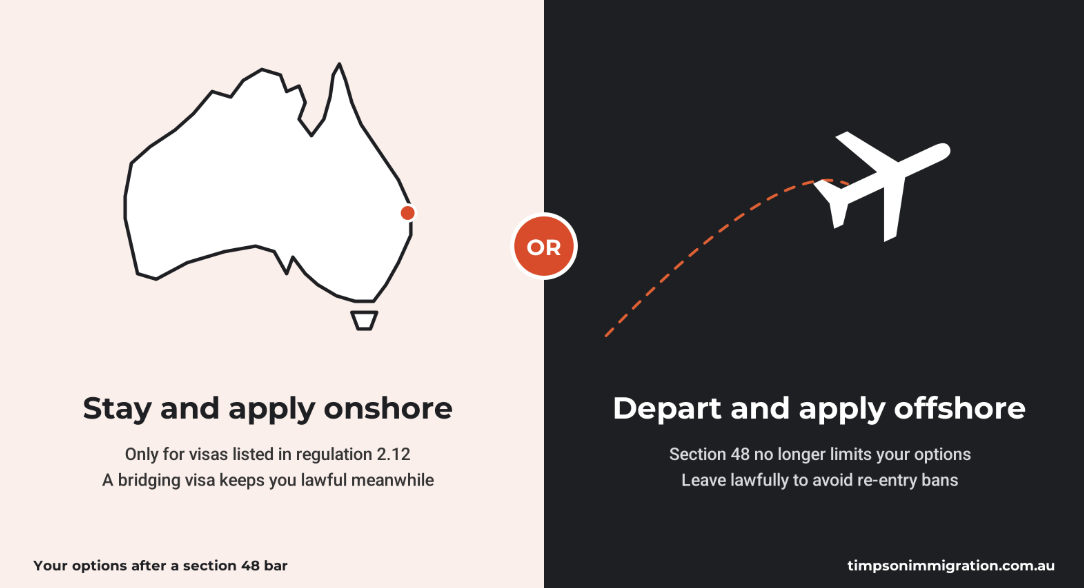
After a refusal, you either stay and apply for an exempt visa, or leave and apply from outside Australia.
| Option | Best for | Can you stay in Australia? | Main risk |
| ART review | Refusals with errors or new evidence | Usually, on a bridging visa | Strict lodgement deadlines |
| Exempt onshore visa | People who qualify for a visa listed in regulation 2.12 | Yes | Schedule 3 criteria (for partner visas) |
| Depart and apply offshore | People with no exempt option | No | Re-entry bans if you became unlawful |
| Ministerial Intervention | Exceptional cases after the ART | Sometimes | Discretionary with no guaranteed outcome |
Leaving Australia ends the section 48 bar for future applications. Leave while you hold a valid bridging visa. If you stay unlawfully for more than 28 days, you can face a three-year exclusion period on top of everything else.
Appealing a Refusal at the Administrative Review Tribunal (ART)
The Administrative Review Tribunal (ART) replaced the AAT on 14 October 2024. Many refusals and cancellations can be reviewed by the ART. If the Tribunal sends your case back to the Department, your original application is decided again.
Deadlines are short and unforgiving. For many onshore refusals, you have 21 days from notification. Your decision letter states the exact deadline. Read our guide to appealing a visa refusal in Australia and act before the window closes.
Ministerial Intervention and Section 48B
No waiver exists for the section 48 bar itself. Two Ministerial Intervention powers are relevant:
- Section 351: After the ART affirms a refusal, the Minister can personally substitute a more favourable decision if it is in the public interest. The Minister has no duty to consider your request.
- Section 48B: This power lets the Minister lift the section 48A bar on a repeat protection visa application. It does not lift section 48. The Minister signed new Ministerial Instructions on 4 September 2025 that changed how requests under section 351, section 501J and subsection 48B(1) are handled. If the bar is lifted, you have seven working days to lodge a fresh application.
The Department of Home Affairs publishes details on its Ministerial Intervention page. Requests succeed only in exceptional cases, so a well-prepared submission matters.
Section 48 Bar FAQs
What is the section 48 bar?
It is a rule in the Migration Act that stops you applying for most visas onshore if you hold no substantive visa and had a visa refused or cancelled since your last arrival in Australia.
Can I apply onshore after a refusal?
Only for a visa listed in regulation 2.12, such as a partner, protection or 190 visa. If you still hold a substantive visa, the bar does not apply until that visa ends.
Does a visa cancellation trigger the section 48 bar?
Yes, if the cancellation was under certain powers, including sections 109 and 116. Character cancellations under section 501 trigger a separate bar under section 501E.
Can I apply for a partner visa with a section 48 bar?
Yes. Partner visas (820/801) are exempt. You may also need to meet Schedule 3 criteria and show compelling reasons for a waiver.
How do I remove the section 48 bar?
You can depart Australia and apply offshore, apply for an exempt visa or have the refusal overturned at the ART.
Is the ART the same as the AAT?
The ART replaced the AAT on 14 October 2024. Any guide that still refers to the AAT for new appeals is out of date.
Get Your Next Step Right the First Time
One invalid application can cost you months and close off options you still have. At Timpson Immigration Lawyers, we review your refusal or cancellation, confirm whether the section 48 bar applies and map out your strongest pathway. We have more than 47 years of collective experience and a 99.6% success rate, with fixed fees so you know the cost upfront.
Book a strategy session this week. ART deadlines move fast, so speak to our Brisbane team before you lodge anything else.