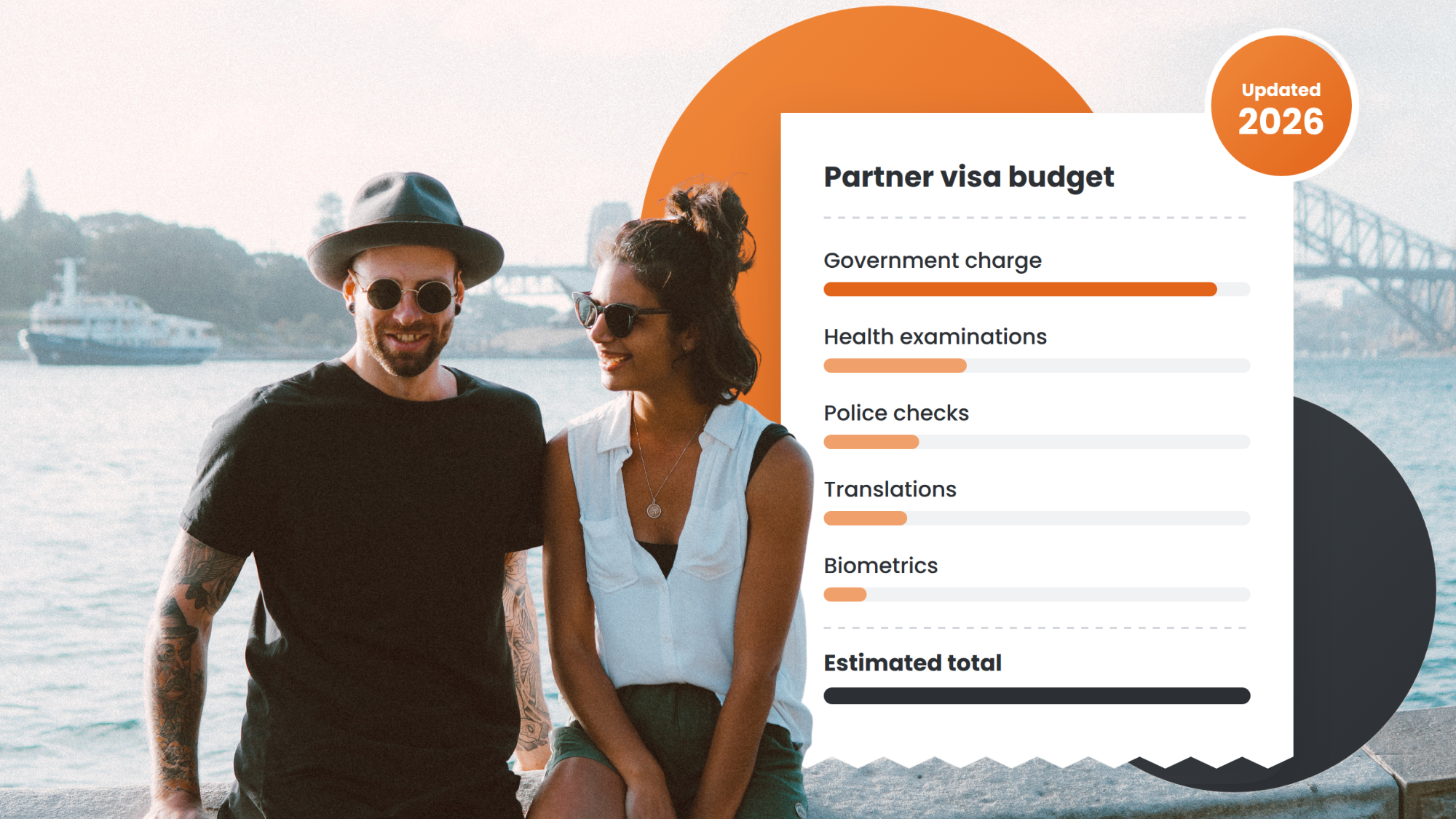
When applying for an Australian partner visa, the first thing most couples want to know is the government fee. As of 1 July 2026, that number went up. The base application for a partner visa rose from $9,365 to AUD $11,710 for most main applicants, and is now one of the largest visa charges the Department of Home Affairs sets.
Your total partner visa Australia cost is more than the government charge, though. Medicals, police checks, translations and legal fees all sit on top of it. The difference between a budget that holds and one that blows out usually comes down to preparation.
This guide breaks down the full partner visa cost in Australia for 2026: what the Department charges, what the extra costs are, what a lawyer costs and why, and what a realistic total looks like for a single applicant or a couple. Figures change with indexation, so treat every amount here as a starting point to confirm before you lodge.
If you want the steps rather than the numbers, our how to apply for a partner visa guide walks through the full application from start to finish.
How much does a partner visa cost in Australia in 2026?
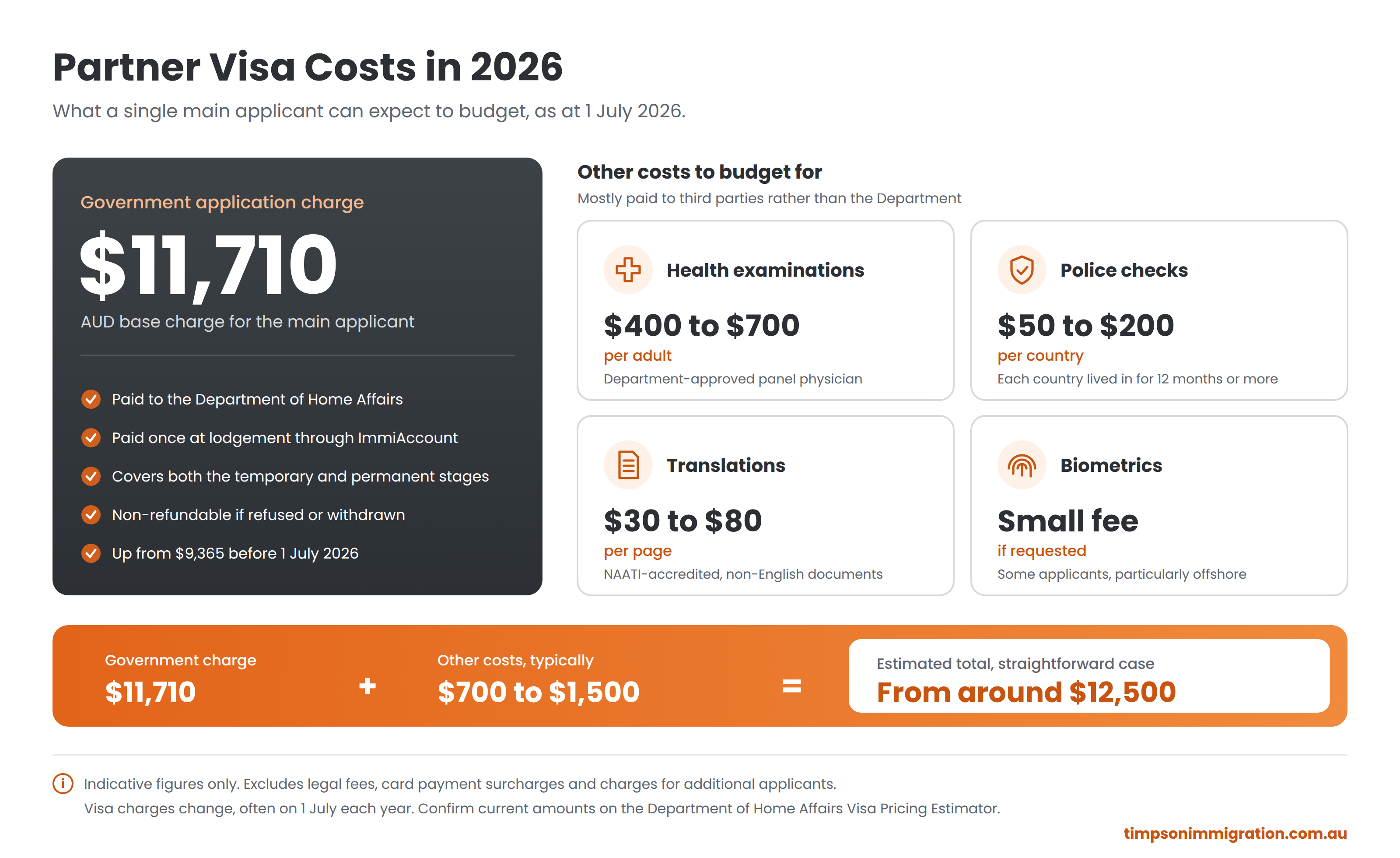
For most main applicants, the Department of Home Affairs base application charge is AUD $11,710, current as at 1 July 2026. That single charge covers the whole partner visa pathway, both the temporary and the permanent stage.
On top of the government charge, most couples spend a further $700 to $1,500 or so on health examinations, police checks and document costs. If you engage an immigration lawyer, professional fees are quoted separately and depend on how complex your case is.
So a single-applicant partner visa in 2026 usually starts from around $12,500 all in. More complex applications, or applications that include children, cost more. We break each part down below. Before you budget for any of this, it is worth confirming you actually meet the partner visa requirements, since lodging on the wrong basis risks the entire fee.
Note: Visa charges change, often on 1 July each year. Always confirm the current amount on the Department of Home Affairs Visa Pricing Estimator before you pay.
What the partner visa application charge covers
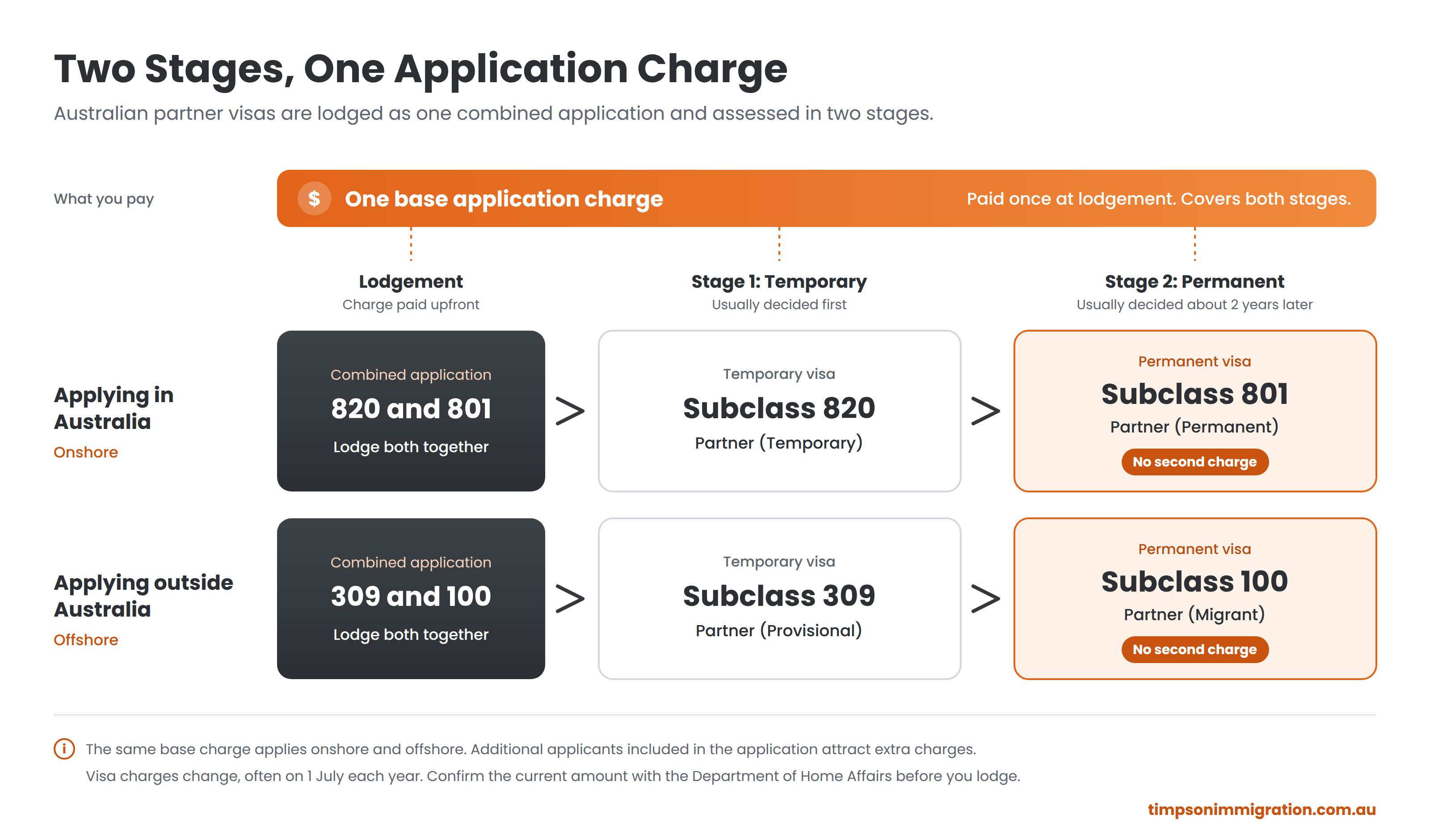
A partner visa is a two-stage visa with one application. You lodge once, you pay once and the Department assesses your case in two steps.
- Onshore, you apply for the Subclass 820 (temporary) and Subclass 801 (permanent) together.
- Offshore, you apply for the Subclass 309 (temporary) and Subclass 100 (permanent) together.
- Engaged couples where the applicant is overseas may instead use the Prospective Marriage visa (Subclass 300), then apply onshore after marrying.
The base charge covers both stages. There is no second Department charge when your permanent visa is decided, usually about two years later. The same base charge of $11,710 applies whether you lodge onshore, offshore or as a Prospective Marriage visa applicant.
For an overview of how the two stages fit together, see our guide to the Australian partner visa. If you are not yet sure which pathway suits you, our guide to what types of partner visas are available runs through the options.
Partner visa cost breakdown: government fees
The Department of Home Affairs application charge in 2026
The base application charge is the single biggest cost in any partner visa. As at 1 July 2026 it is AUD $11,710 for the main applicant. This is the figure that increased at the start of the financial year, up from $9,365, so any older article or fee screenshot you find online is likely out of date. For the Department’s full schedule, see our overview of the fees and charges for visa applications.
This charge is the same for the onshore 820/801 and the offshore 309/100. It is paid when you lodge, through ImmiAccount, and your application cannot be processed until the correct charge is paid.
Additional applicants and the card surcharge
The base charge covers one main applicant. If your application includes other people, extra charges apply:
- An applicant aged 18 or over who is included in the application attracts an additional charge, historically close to half the main charge.
- A dependent child under 18 attracts a smaller additional charge.
These amounts also move with indexation, so check them on the Visa Pricing Estimator rather than relying on a fixed number.
One cost many couples miss is the payment surcharge. If you pay by card through ImmiAccount, the Department applies a surcharge on top of the charge. Published rates are around 1.4% for Visa and Mastercard, which adds roughly $164 to the main charge, with different rates for PayPal and UnionPay.
Other costs to budget for
The government charge is not the whole picture. Every partner visa also involves a set of smaller costs that add up, and most of them are paid to third parties rather than the Department.
- Health examinations with a Department-approved panel physician, usually around $400 to $700 per adult depending on where you have them done and what tests are required.
- Police checks for every country you have lived in for 12 months or more, generally from around $50 to $200 per country.
- Document translations by a NAATI-accredited translator for anything not in English, commonly $30 to $80 per page.
- Biometrics, which some applicants (particularly offshore) are asked to provide for a small fee.
If an applicant has a significant medical condition, a health waiver may be available in limited circumstances, which can affect both cost and outcome.
For a single applicant with a clean history, these extras often total $700 to $1,500. For couples with children, several countries of residence or a stack of foreign-language documents, they climb from there.
Once your application is lodged, many onshore applicants can also access Medicare, which can reduce ongoing healthcare costs while you wait for a decision.
Legal costs: what you pay an immigration lawyer for
A partner visa is one of the few applications you can lodge yourself. Many people do. The reason couples still choose to work with an immigration lawyer comes down to what is at stake if it goes wrong.
With a charge above $11,000 that is not refundable, a refusal is expensive twice over. You lose the charge, and you often lose months or years before you can re-apply. Preparation is what protects that outlay.
This is where the difference between a lawyer and a migration agent matters. As immigration lawyers, our job is to read the legislation, build the evidence to the standard a case officer expects and set the application up correctly the first time. With immigration, you often get one shot to get it right.
At Timpson Immigration Lawyers, partner visa work is offered as fixed-fee pricing with no surprises, so you know the cost before you commit. It starts with a free 15-minute discovery call, then a paid consultation with a lawyer (currently $440).
Professional fees for the full application are quoted separately and depend on the complexity of your case, including whether there are children, prior refusals or offshore documents involved. You can read more about how we work with couples on our partner visa lawyers page.
What a partner visa really costs in 2026: sample budgets
Every case is different, so treat the figures below as indicative planning numbers rather than a quote. They assume the current $11,710 base charge and are subject to change.
| Scenario | Rough all-in estimate |
| Single applicant, straightforward history | From around $12,500 |
| Applicant plus one dependent child | Add the child’s additional charge and a medical for each person |
| Complex history (multiple countries, foreign documents, prior refusal, legal representation) | Can exceed $16,000 |
The government charge is the bulk of the cost, the extras add several hundred to a few thousand dollars and complexity is what pushes a budget higher. Knowing your likely total before you start is far easier than finding an extra few thousand dollars mid-application.
[IMAGE PLACEHOLDER: ImmiAccount payment screen showing the visa application charge and card surcharge at lodgement. Alt text: “ImmiAccount payment screen showing the partner visa application charge and card payment surcharge.”]
Onshore, offshore and Prospective Marriage visa costs compared
A common question is whether one partner visa pathway is cheaper than another. For most main applicants, the base charge is the same.
- The onshore Subclass 820/801 and the offshore Subclass 309/100 carry the same base application charge.
- The Prospective Marriage visa (Subclass 300) carries a similar base charge at the 300 stage. Couples who later apply onshore after marrying then pay a much smaller charge at the partner visa stage, because the main charge was already paid. Confirm the current concession amount before relying on it.
Whether you are married or in a de facto relationship makes no difference to the government charge. A de facto partner visa is priced the same as a married partner visa. Same-sex and LGBTI partner visa applications are assessed on the same basis. The right pathway depends on where you are when you apply and your circumstances, not on which price looks lower.
The application charge is non-refundable, so preparation pays
Once you lodge and pay, the Department keeps the charge even if your application is refused or you withdraw it. There is no partial refund for a weak application. That single fact is why the partner visa application process rewards careful preparation over speed.
Rather than build that checklist twice, our how to apply for a partner visa guide walks through exactly what to gather and in what order. Working through that checklist before you lodge is what protects the $11,710 you have just paid.
Cost and timing go together, too. A partner visa can take well over a year at the temporary stage, so the charge you pay today buys a process that runs for a long time. Our guide to partner visa processing times sets out the current bands.
Frequently asked questions
How much does a partner visa cost in Australia in 2026?
For most main applicants, the Department of Home Affairs base application charge is AUD $11,710, current as at 1 July 2026. That single charge covers both the temporary and permanent stages. Most couples also spend $700 to $1,500 more on medicals, police checks and documents, so a straightforward application starts from around $12,500. Confirm the current charge on the Department’s Visa Pricing Estimator before you lodge.
Why did the partner visa cost increase in 2026?
The Department of Home Affairs reviews its visa application charges each financial year, and increases usually take effect on 1 July. From 1 July 2026, the partner visa base charge rose from $9,365 to $11,710 for most main applicants. The increase is tied to annual indexation rather than any change to the visa itself.
Does the partner visa fee cover both the 820 and the 801?
Yes. The base application charge covers the whole pathway, both the temporary stage (820 onshore or 309 offshore) and the permanent stage (801 or 100). You do not pay a second Department charge when the permanent visa is decided. Costs like medicals and police checks are separate and may need to be redone if a long time passes.
Is the partner visa application charge refundable if I am refused?
No. The application charge is not refundable if your visa is refused or if you withdraw the application. This is a key reason to lodge a well-prepared, decision-ready application rather than rushing. If you have had a visa refused before, it is worth getting legal advice before you lodge again.
How much does a de facto partner visa cost?
A de facto partner visa costs the same as a married partner visa. The government base charge does not change based on whether you are married or in a de facto relationship. De facto couples generally need to show the relationship has existed for at least 12 months before applying, unless it is registered or another exception applies.
Is the offshore partner visa cheaper than the onshore one?
No. The onshore Subclass 820/801 and the offshore Subclass 309/100 carry the same base application charge for most main applicants. The right pathway depends on where you are when you apply and your circumstances, not on price. Choosing a pathway to save money can cost far more if it turns out to be the wrong fit.
Do I lose my partner visa application fee if the relationship breaks down?
Generally yes, the application charge is not refunded simply because the relationship has ended. There are limited exceptions, such as family violence provisions or where there is a child of the relationship, that may allow an application to continue. Given what is at stake financially, this is a situation worth getting legal advice on before you act.
Getting your partner visa cost right
A partner visa is a significant financial commitment in 2026, and the government charge is only part of it. The couples who avoid nasty surprises are the ones who map out the full cost early and prepare the application properly so the money is not put at risk.
At Timpson Immigration Lawyers, we work with couples across Australia and overseas to plan, price and prepare partner visa applications that are right the first time, with fixed fees and no hidden costs. If you are weighing up a partner visa, book a consultation with one of our immigration lawyers and we will help you move forward with confidence. You can also start with our free Check-it Assessment to see where your application stands.
This article is general information only and is not legal advice. Immigration law and visa charges change frequently. Please confirm current fees and requirements with a qualified immigration lawyer or the Department of Home Affairs. Last reviewed: July 2026.