Applying for a partner visa is one of the biggest steps a couple takes together. It is also one of the most document-heavy applications in the Australian system.
While the application is lodged online, determining eligibility and presenting persuasive, consistent evidence can be complex. The Department of Home Affairs (DHA) assesses both the legal requirements and the circumstances of each relationship, and seemingly small gaps or inconsistencies can affect the outcome.
This guide explains how to apply for a partner visa in Australia and what to expect at each stage: how eligibility is assessed, what evidence the Department looks for, how the visa and sponsorship applications fit together and how long the process usually takes. We keep the numbers light here and focus on the shape of the process. For a full cost breakdown, see our guide to how much a partner visa costs.
Note: This is general information, not legal advice. Immigration rules change often. With a non-refundable application charge above $11,000, it pays to get the application right the first time.
What is a partner visa?
A partner visa lets the spouse or de facto partner of an Australian citizen, permanent resident or eligible New Zealand citizen live in Australia.
There are three main pathways, and they do not all work the same way:
- The onshore partner visa (subclass 820 and 801), for applicants who are in Australia when they apply.
- The offshore partner visa (subclass 309 and 100), for applicants who are outside Australia when they apply.
- The Prospective Marriage visa (subclass 300), for engaged couples where the applicant is overseas and intends to marry.
The 820/801 and 309/100 pathways are two-stage combined applications. You apply once and pay once, and the Department assesses the temporary stage first and the permanent stage later.
The subclass 300 is different. The Department describes it as a visa that lets you travel to Australia, marry your prospective spouse and then apply for a partner visa. It is a separate application with a separate charge, so a subclass 300 applicant should plan and budget for both.
Partner visas are open to married and de facto couples, and to same-sex and LGBTI applicants on the same basis. If you are not sure which pathway fits, our guide to what types of partner visas are available runs through the options.
Before you apply: the assessment that comes first
The most expensive mistakes in a partner visa happen before anyone opens an application form. They happen when a couple applies for the wrong visa, applies at the wrong time, or applies without knowing about a barrier that was there all along.
This is the part of the process that is genuinely legal work, and it is worth doing properly.
Do both the applicant and the sponsor qualify?
The applicant must be the spouse or de facto partner of the sponsor. The sponsor must be an Australian citizen, permanent resident or eligible New Zealand citizen.
Sponsorship is not automatic. Limitations can apply where the sponsor has sponsored a partner before, where they were themselves sponsored for a partner visa, or where there are character concerns. Sponsors are also assessed and may need to provide police certificates. Our guide on sponsoring a partner explains the sponsor’s role in more detail.
Does the relationship meet the legal requirement?
Married couples need a marriage that is valid under Australian law. De facto couples generally need to show the relationship has existed for at least 12 months immediately before applying, unless the relationship is registered with a state or territory or another exception applies. A de facto partner visa is assessed on the same relationship criteria as a married application.
Time together is not enough on its own. The Department also assesses whether you have a mutual commitment to a shared life to the exclusion of all others, whether the relationship is genuine and continuing, and whether you live together or do not live separately and apart permanently.
What does the applicant’s current visa allow?
For onshore applicants, this is often the deciding factor and it is frequently overlooked. Your current visa, its conditions and its expiry date can affect whether you can apply onshore at all, what bridging visa you receive and what rights that bridging visa carries.
Conditions such as “No Further Stay” can prevent an onshore application unless the condition is waived. A previous visa refusal or cancellation can also limit what can be applied for while you are in Australia. If any of that applies to you, get advice before you do anything else.
Are you ready to lodge a complete application?
The Department expects applications to be decision-ready at lodgement. In practice, that means the evidence should be in place when you apply rather than gathered afterwards.
Our free partnership visa eligibility quiz is a useful starting point, and our overview of partner visa requirements sets out what the Department looks for. If you want your evidence reviewed for quality and completeness before you lodge, our Check-it Assessment does exactly that.
How to apply for a partner visa in Australia: what to expect
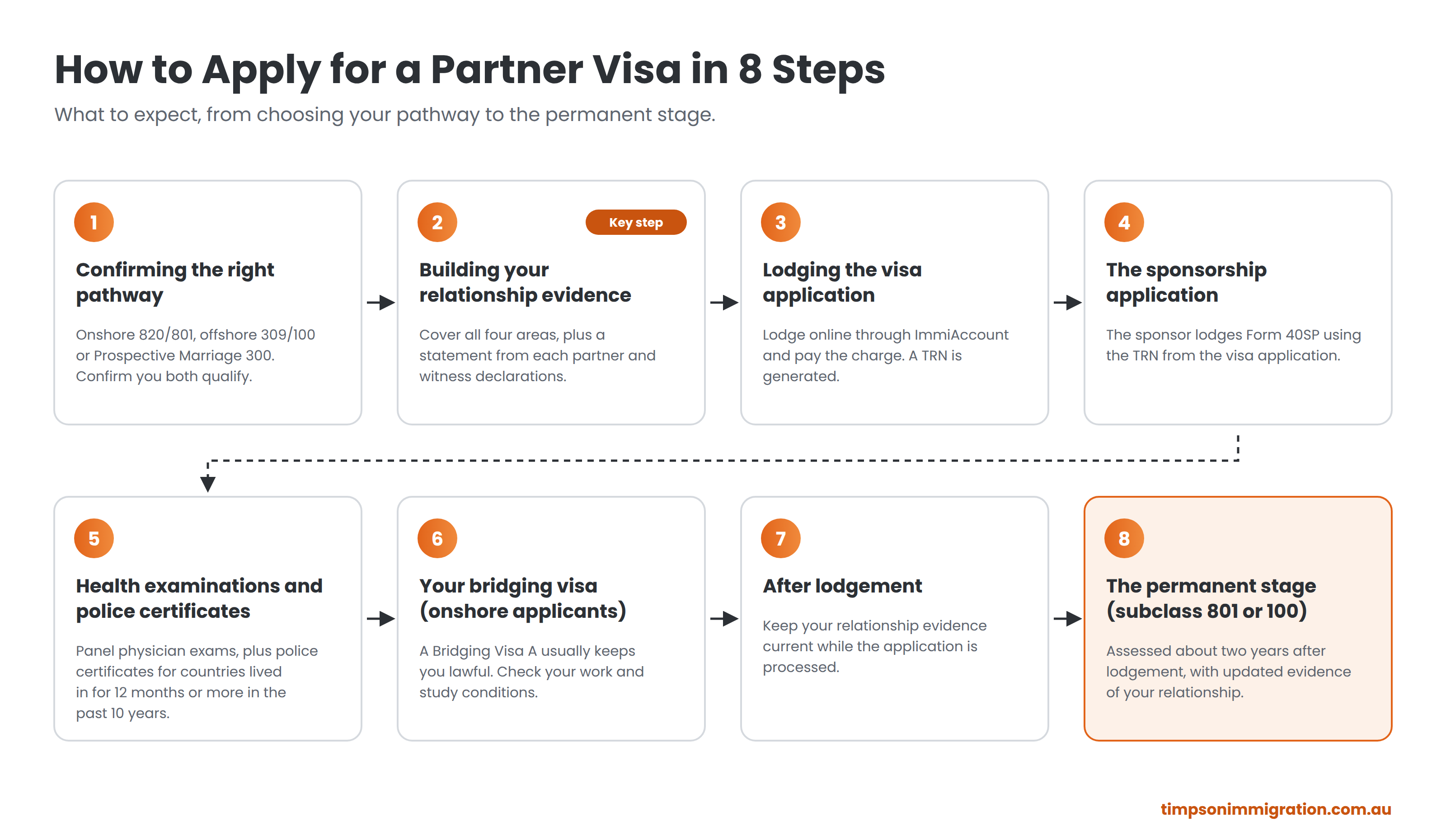
The stages below describe how a partner visa application usually unfolds. They are a guide to what is involved, not a substitute for advice on your own circumstances. Where you are located, what visa you currently hold and what your relationship history looks like can all change the strategy.
1. Confirming the right pathway
Decide whether you are applying onshore (820/801), offshore (309/100) or as a Prospective Marriage visa applicant (300), and confirm that both applicant and sponsor qualify.
The choice is not simply about where you happen to be. It affects your bridging visa position, your ability to travel, your work rights and what happens if your circumstances change during processing. This is the stage where advice saves the most money, because a wrong turn here is expensive to undo.
2. Building your relationship evidence
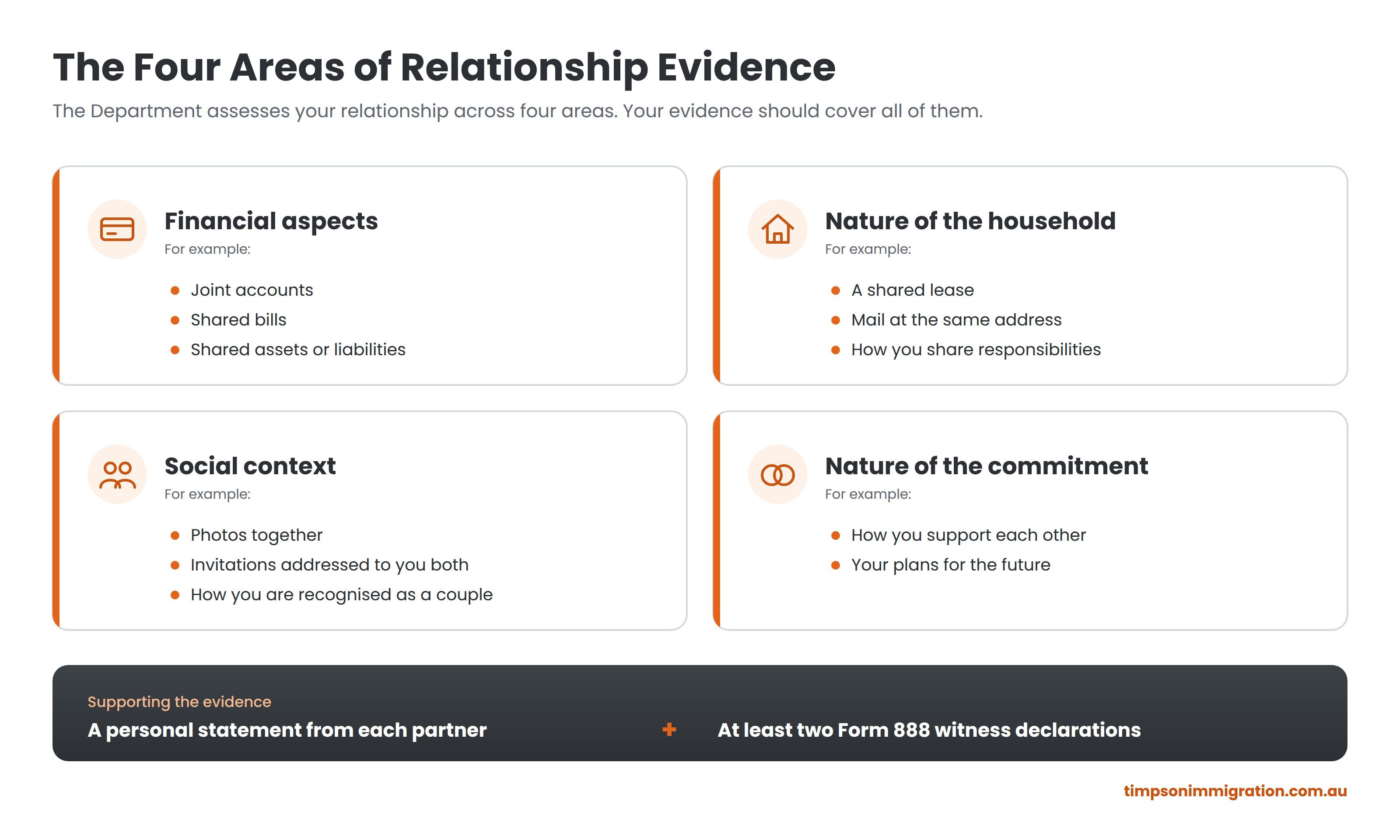
This is the heart of the application. The Department assesses your relationship across four areas, and your evidence should cover all of them:
- Financial aspects, such as joint accounts, shared bills and shared assets or liabilities.
- Nature of the household, such as a shared lease, mail at the same address and how you share responsibilities.
- Social context, such as photos together, invitations addressed to you both and how you are recognised as a couple.
- Nature of the commitment, such as how you support each other and your plans for the future.
You and your sponsor each provide a personal statement about the relationship, and you need at least two Form 888 witness declarations from people who know you as a couple. Couples who met online can still build a strong case, they just need to document how the relationship developed.
Volume is not the same as strength. A well-chosen set of documents that tells one consistent story is far more persuasive than hundreds of pages that leave a category thin. Our guide to partner visa evidence sets out what strong evidence looks like.
3. Lodging the visa application
Partner visa applications are lodged online through ImmiAccount, the Department’s application portal. The main applicant completes the partner visa application, which is the online equivalent of Form 47SP, covering both partners, the relationship and any dependants.
The application charge is paid at lodgement. For most main applicants the base charge is AUD $11,710 (current as at 1 July 2026) and it covers both the temporary and permanent stages of a combined application. The charge is indexed and changes, so confirm the current figure on the Department’s Visa Pricing Estimator before you lodge. It is not refundable if the application is refused.
Once the visa application has been made, a Transaction Reference Number (TRN) is generated. That number matters for the next step.
4. The sponsorship application
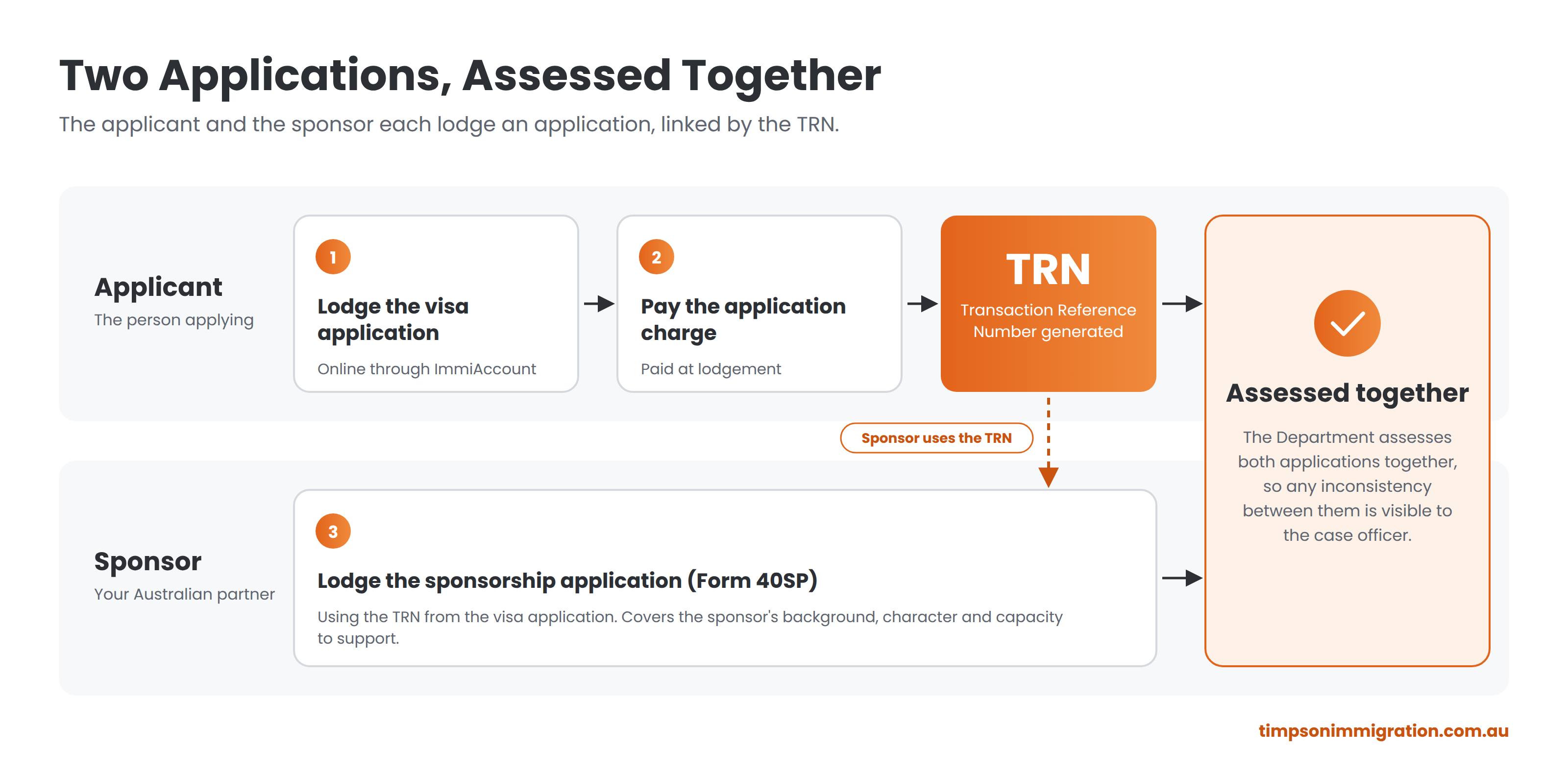
The sponsor lodges a separate sponsorship application, Form 40SP, using the TRN from the applicant’s visa application. This is why the order matters: the sponsorship cannot be linked until the visa application has been made.
The sponsorship application covers the sponsor’s background, character and capacity to support the applicant. The two applications are assessed together, so any inconsistency between them is visible to the case officer.
5. Health examinations and police certificates
Every applicant must meet Australia’s health requirement. Applicants and any included family members may be asked to complete a health examination with a Department-approved panel physician, with the tests required depending on your circumstances. Where examinations are done, results are generally valid for 12 months and may need to be repeated if they expire before a decision is made.
Police certificates are generally required for each country in which the person has spent a total of 12 months or more during the past 10 years. Sponsors are also usually required to provide police certificates, including Australian certificates.
If an applicant has a significant medical condition, a health waiver may be available in limited circumstances. Our overview of health requirements for Australian visas explains what is assessed.
6. Your bridging visa (onshore applicants)
If you lodge onshore while you hold a substantive visa, you are usually granted a Bridging Visa A. It takes effect when your current visa ends and keeps you lawful in Australia while the application is assessed.
Do not assume your existing work or study rights carry over. The conditions attached to a bridging visa vary, and you should check your grant notification or VEVO to confirm exactly what your bridging visa allows.
7. After lodgement
Keep your evidence current while you wait. Relationships continue during processing, and updated evidence of an ongoing, genuine relationship strengthens the application.
Do not rely on being asked to fix a weakness. The Department can decide an application on the information provided, without first inviting you to correct or add to it. That is why a complete application at lodgement is your best protection, and why avoiding the common mistakes made on Australian partner visa applications matters so much.
8. The permanent stage (subclass 801 or 100)
The permanent stage of the combined application (820/801 or 309/100) is generally assessed about two years after lodgement. Both components are lodged together, but they are assessed separately. The temporary visa is decided first, then the permanent stage is assessed later, and at that point you need to provide updated evidence that the relationship is continuing.
Where a couple was in a long-term relationship at the time of application, the permanent visa can sometimes be granted earlier. Our guide to the second stage of the partner visa explains what is required.
How long does the partner visa application process take?
Partner visa timelines change month to month, and the Department publishes them as percentiles rather than averages.
In recent figures, the temporary stage is taking roughly 16 to 18 months for half of applicants and up to about 24 months for 90 per cent. Well-prepared applications without character or health complications tend to sit in the lower band, though nothing about processing time is guaranteed.
Two things influence the wait. Partner visas are demand driven rather than capped, so the queue reflects application volumes and how the Department resources processing. Because these figures move, check the current visa processing times rather than relying on a number you read months ago.
What does it cost to apply?
The base application charge is AUD $11,710 for most main applicants (current as at 1 July 2026), and for combined applications that single charge covers both the temporary and permanent stages. A Prospective Marriage visa applicant pays a separate charge for the subsequent partner visa application.
On top of the charge, budget for health examinations, police certificates, document translations and any professional fees. Charges are indexed annually, so always confirm the current amount before lodging. Our partner visa cost guide breaks the full budget down.
Where partner visa applications go wrong
Partner visa problems usually start in one of two places. Either the couple does not yet meet the criteria for the visa they are applying for, or the application is not prepared and evidenced properly. The recurring ones we see:
- Applying before the relationship meets the legal definition, including the 12 month de facto requirement where no relationship registration applies.
- Applying on the wrong pathway for the couple’s circumstances.
- Thin evidence in one of the four categories, usually the financial or social side.
- Treating the sponsorship application as a form-filling exercise.
- Missing a visa condition or a sponsorship limitation that was identifiable from the outset.
- Inconsistencies between the applicant’s statement, the sponsor’s statement and the documents.
If your relationship changes during processing, get advice quickly. Limited protections exist, including family violence provisions, and our guide to a relationship breakdown during a partner visa explains the options.
What an immigration lawyer does that you cannot easily do yourself
Anyone can complete an online form. The value is in everything around it, and that is where applications are won or lost.
When Timpson Immigration Lawyers acts on a partner visa, we:
- confirm that both applicant and sponsor are eligible before you lodge and pay a non-refundable Department application charge
- identify visa conditions, sponsorship restrictions and other legal risks
- develop an evidence strategy built around your particular relationship
- review the chronology and resolve inconsistencies before the Department sees them
- help prepare persuasive, credible relationship statements
- identify weak evidence areas and recommend how they can properly be addressed
- ensure the visa and sponsorship applications tell one consistent story
- manage requests, changes in circumstances and complications after lodgement
We are lawyers, not only form-preparers. With a non-refundable charge and a two-year assessment period, you usually get one clean shot at this.
Frequently asked questions
How do I apply for a partner visa in Australia?
The main applicant lodges the partner visa application online through ImmiAccount and pays the application charge. Once the visa application has been made, a Transaction Reference Number is generated and the sponsor uses it to lodge a separate sponsorship application. Identity, relationship, health and character evidence is provided in support, and for combined applications the Department assesses the temporary stage first and the permanent stage later.
What documents do I need for a partner visa?
You need identity documents such as passports and evidence of any name change, evidence of a genuine relationship across the four categories (financial, household, social and commitment), a personal statement from each partner and at least two Form 888 witness declarations. Health examination results and police certificates are also required, and sponsors generally need police certificates too.
How long does a partner visa take in 2026?
Recent Department figures show the temporary stage taking around 16 to 18 months for half of applicants and up to about 24 months for 90 per cent. Timelines change regularly, so check current processing times before relying on them. A complete, well-prepared application avoids the delays that come from requests for further information.
Can I work while my partner visa is being processed?
It depends on your visa pathway and the conditions on your bridging visa, so check your grant notification or VEVO to confirm what applies to you. For more on bridging visas and work rights, see our guide to bridging visas.
Can I apply for a partner visa if we are not married?
Yes. De facto couples are assessed on the same relationship criteria as married couples. You generally need to show the relationship has existed for at least 12 months immediately before applying, unless it is registered with a state or territory or another exception applies.
Can I access Medicare while my partner visa is being processed?
Many onshore partner visa applicants can enrol in Medicare once the application has been lodged, including while on a bridging visa. Eligibility depends on your circumstances and the visa you have applied for, so confirm your own position with Services Australia after lodging.
What happens to my partner visa if the relationship breaks down?
If the relationship ends before a decision, the application is generally affected, though limited exceptions exist, including family violence provisions and cases where there is a child of the relationship. This is complex and fact-specific, so get legal advice before taking any step, including withdrawing.
Getting your partner visa application right
A partner visa rewards getting it right the first time. The couples who avoid delays and refusals are usually the ones who confirmed their eligibility properly, built their evidence deliberately and lodged a complete application instead of rushing to submit.
At Timpson Immigration Lawyers, we work with couples across Australia and overseas to plan, prepare and lodge partner visa applications, with fixed-fee pricing and no hidden costs. If you are getting ready to apply, book a call with our partner visa lawyers and we will help you move forward with confidence.
This article is general information only and is not legal advice. Immigration law and visa charges change frequently. Please confirm current requirements with a qualified immigration lawyer or the Department of Home Affairs. Last reviewed: September 2026.